
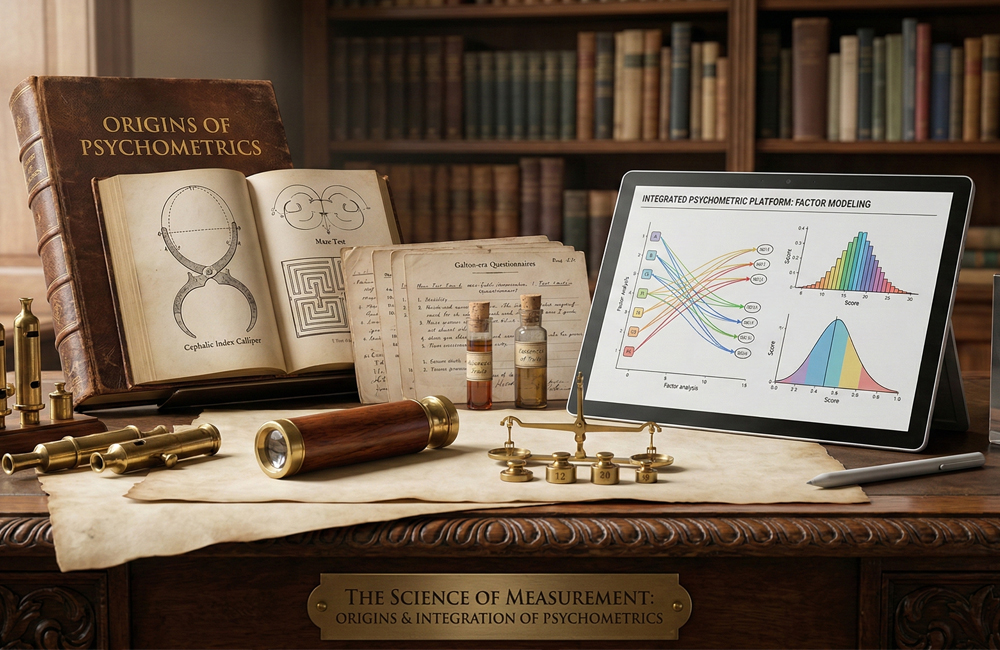
The Science of Measurement: Origins & Integration of Psychometrics
Psychometrics is the scientific field dedicated to measuring psychological traits such as intelligence, personality, aptitude, and emotional patterns. Over the past century, it has evolved into an essential tool in psychology, medicine, education, and behavioural research. Today, psychometrics also plays an important role in holistic healthcare systems by helping clinicians evaluate mental and emotional states with measurable precision.
Origins of Psychometrics
The roots of psychometrics can be traced to the late nineteenth century, when scientists began exploring ways to quantify human intelligence and behavioural differences.
- Francis Galton: A pioneer in psychological measurement, Galton established the Anthropometric Laboratory in London where he collected data on sensory perception, reaction time, and cognitive abilities.
- James McKeen Cattell: In the 1880s, Cattell introduced the concept of “mental tests.” His research integrated statistical analysis with experimental psychology, helping establish the foundation of modern psychometric assessment.
Development of Psychometrics in Medical Science
During the early twentieth century, psychometrics advanced rapidly through the development of statistical methods such as correlation, factor analysis, and reliability testing. These techniques enabled researchers to create standardized psychological tests that could be validated scientifically.
Clinical Applications
- Cognitive Testing: Intelligence tests became crucial tools for identifying intellectual disabilities and learning challenges.
- Personality Assessment: Standardized personality inventories helped clinicians evaluate emotional patterns and psychiatric conditions.
- Neuropsychological Evaluation: Psychometric tests are used to detect brain injuries, dementia, and cognitive impairments.
In modern healthcare, psychometrics is widely used for screening mental health conditions, evaluating treatment outcomes, and guiding therapeutic interventions in child development, rehabilitation, and occupational health.
Integration of Psychometrics with Homoeopathy
Homoeopathic medicine emphasizes individualised treatment based on the totality of symptoms, including mental and emotional states. Psychometric testing complements this approach by providing objective measurements of psychological traits through structured assessments such as personality inventories and behavioural scales.
By analysing these measurable traits, practitioners gain deeper insights into the patient's psychological constitution. This helps refine remedy selection and supports a more systematic approach to individualized treatment.
Enhancing Individualised Treatment
Psychometric assessments can reveal subtle mental characteristics that may not always emerge during routine consultation. Traits such as anxiety patterns, emotional responses, and behavioural tendencies can guide practitioners in selecting the most suitable remedy and determining treatment strategies.
| Aspect | Psychometric Role | Homoeopathic Benefit |
|---|---|---|
| Mental Symptoms | Quantifies personality traits and behaviour | Helps match characteristic symptoms |
| Susceptibility | Measures responsiveness to treatment | Guides potency and repetition |
| Follow-up | Tracks changes through repeated assessments | Confirms improvement and direction of cure |
Real-World Applications
Clinics that integrate psychometric evaluation with holistic healthcare approaches can provide more structured and evidence-based treatment. This integration supports better management of stress-related conditions, emotional imbalances, and cognitive difficulties.
By combining traditional medical insights with scientific psychological measurement, healthcare professionals can deliver more personalised and effective care.
Future Implications
As psychometric research continues to advance, new assessment tools are being developed to improve diagnostic accuracy and treatment evaluation. The integration of psychological measurement with holistic healthcare systems holds significant potential for understanding the complex relationship between mind and body.
Ultimately, psychometrics has evolved from early experiments in measuring intelligence to a cornerstone of modern medical science, enabling precise psychological evaluation and more informed treatment planning.